












What Are Thermal Break Aluminum Windows & Why Are They Essential for Modern Architecture?
A deep technical evaluation into thermal bridge barrier physics, profile extrusions, PA66GF25 structural polyamides, and energy management for B2B project buyers.
When global commercial builders, developers, and facade engineers search for high-efficiency exterior fenestration systems, their core search intent centers around reducing HVAC load, eliminating thermal bridging, and ensuring structural durability against extreme wind loads. Standard extruded aluminum profiles possess an exceptionally high thermal conductivity rate (approximately $k = 160 \text{ to } 200 \text{ W/m}\cdot\text{K}$). Left uninsulated, standard aluminum acts as a direct conductor of heat—transferring scorching summer heat into cooled interiors or bleeding indoor heating to the freezing outside winter air, causing severe condensation, mold growth, and skyrocketing energy bills.
Thermal Break Aluminum Windows solve this thermodynamic inefficiency by introducing a continuous non-conductive structural barrier—a "thermal break"—inserted between the inner and outer aluminum profile extrusions. This composite assembly interrupts thermal radiation and conduction across the building envelope. However, not all thermal break windows manufactured worldwide offer equivalent performance. At Vexis Windows & Doors Co., Ltd., we engineering our profile break systems using high-precision German-standard extrusion technology, PA66GF25 reinforced polyamide strips, multi-chamber thermal cavity insulation, and hermetically sealed double or triple Low-E insulated glass units (IGUs).
The Critical Difference: PA66-GF25 Polyamide vs Low-Cost PVC Strips
A major risk faced by overseas buyers importing window systems from Asia is the covert substitution of structural polyamide thermal strips with cheap Polyvinyl Chloride (PVC) plastic strips. As an authoritative manufacturer with over 20 years of export experience, Vexis Windows & Doors Co., Ltd. enforces a strict zero-PVC thermal barrier policy across all structural thermal break profile series. Here is why the material science matters to your project longevity:
| Engineering Parameter | PA66-GF25 Polyamide (Vexis Standard) | Generic Low-Cost PVC Strips | Impact on Building Envelope |
|---|---|---|---|
| Linear Expansion Coeff. ($\alpha$) | $2.3 \times 10^{-5} \text{ K}^{-1}$ (Matches Aluminum) | $8.0 \times 10^{-5} \text{ K}^{-1}$ (3.5x Higher than Aluminum) | PA66 moves identically with aluminum; PVC expands violently, tearing seals and causing structural failure. |
| Melting / Deflection Point | $250^\circ\text{C} \text{ / } 240^\circ\text{C}$ | $70^\circ\text{C} \text{ / } 65^\circ\text{C}$ | PVC warps, softens, and degrades under intense direct summer sunlight; PA66 retains 100% structural rigidity. |
| Tensile & Shear Strength | $\ge 80 \text{ N/mm}^2$ (25% Glass Fiber Reinforced) | $\le 35 \text{ N/mm}^2$ (Unreinforced Plastic) | PA66 withstands high wind loads, heavy triple glazing, and building settling pressures safely. |
| Expected Lifespan | 50+ Years (Matches Building Life) | 3 to 7 Years (Prone to cracking and air leaks) | Vexis PA66 thermal breaks prevent costly mid-life curtain wall and window replacement projects. |
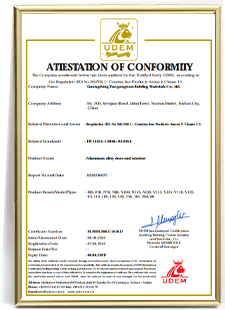
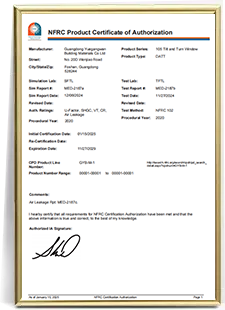
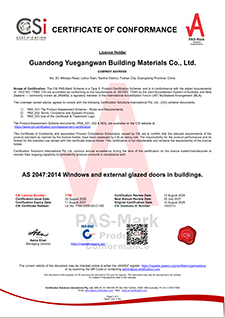
By specifying 6063-T5 or 6063-T6 architectural grade aluminum extrusions combined with 24mm to 34mm wide PA66GF25 polyamide thermal barriers, Vexis Windows & Doors Co., Ltd. produces thermal break aluminum windows that consistently achieve whole-window U-factors down to 0.8 - 1.2 W/m²K (0.14 - 0.21 BTU/h·ft²·°F). This exceeds stringent North American NFRC standards, European CE energy directives, and Australian AS2047 requirements.
 Casement
 Sliding
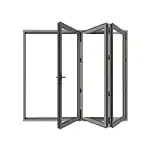 Folding
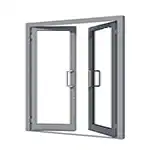 Swing
Swing Entry
Entry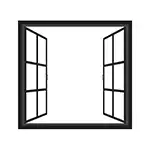 Casement
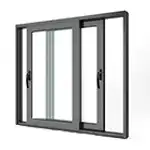 Sliding
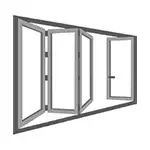 Folding
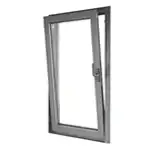 Tilt & Turn
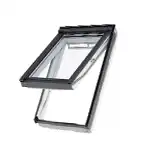 Skylight
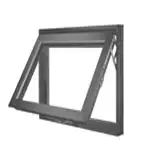 Awning