Featured Aluminum Glass Front Door Systems
Engineered in our 30,000 m² Foshan manufacturing base, engineered specifically to satisfy Japanese thermal efficiency, structural safety, and minimal architectural aesthetics.
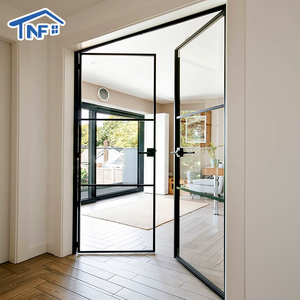
Residential Main Front Entry Aluminum Alloy Double Tempered Glass Security Door
Contact Us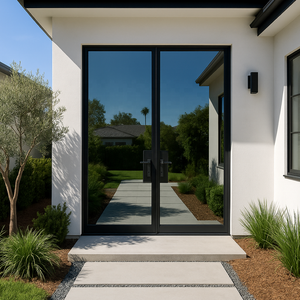
Heavy Duty Thermal Break Soundproof Double Glass Swing Entrance Door for Hotels
Contact Us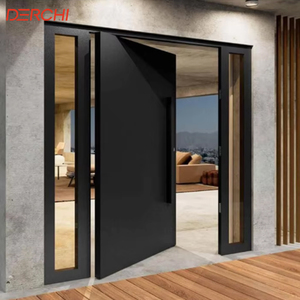
High Quality Modern Exterior Cast Aluminium Glass Pivot Security Entry Door
Contact Us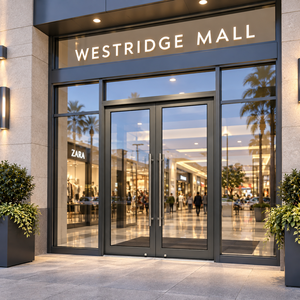
Hihaus Commercial Glass Front Door Office Store Shopping Mall Aluminum Spring Door
Contact Us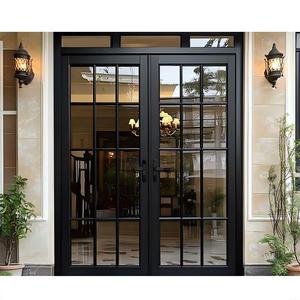
Customized Exterior Front Entry Aluminum French Doors with Double Glazing
Contact Us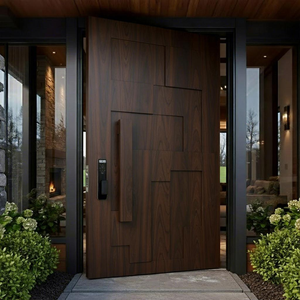
Luxury Modern Exterior Aluminum Pivot Entry Door with Thermal Break Profile
Contact Us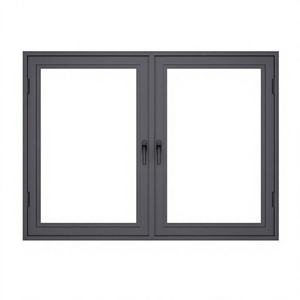
Customized System Aluminum Casement & Pitched Roof Self-Opening Vent Window
Contact Us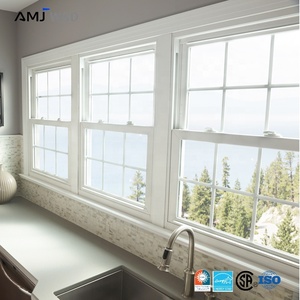
Architectural Black Double Hung Aluminum Sash Window with Tempered Glass
Contact UsEngineering OEM/ODM Aluminum Glass Front Doors for the Japanese Market
Japan’s fenestration and door industry operates under some of the most rigorous performance standards globally. Driven by aggressive zero-energy house (ZEH) initiatives, strict JIS (Japanese Industrial Standards) safety protocols, and severe coastal weathering conditions, architectural door systems imported into Tokyo, Osaka, Hokkaido, or Okinawa must demonstrate exceptional structural integrity. As a premier OEM/ODM aluminium glass front door factory and supplier, Vexis Windows delivers tailored architectural facade systems engineered specifically for Japanese residential contractors, commercial project developers, and trading houses.
Unlike standard commercial door manufacturing, serving Japanese buyers requires an acute understanding of the local entry culture (Genkan), thermal barrier zone specifications (Region 1 to Region 8 under Japanese energy preservation codes), seismic shear deflection resilience, and barrier-free (universal design) sill integration. Our Foshan-based manufacturing headquarters bridges high-capacity precision extrusion manufacturing with custom Japanese engineering compliance.
Technical Evaluation Matrix: Japanese Architectural Standards Compliance
To successfully pass Japanese building inspection and satisfy architectural specifications, custom front entrance doors must comply with quantifiable engineering metrics. Our OEM/ODM production lines configure profile profiles, thermal breaks, and structural glass to exceed the following benchmarks:
| Performance Criteria | Japanese Testing Standard | Vexis OEM/ODM Engineering Value | Architectural Application |
|---|---|---|---|
| Wind Pressure Resistance | JIS A 4702 S-5 / S-6 Grade | Up to 2800 Pa – 3600 Pa ($W_{50}$ Rating) | Typhoon-prone coastal regions (Kyushu, Okinawa) |
| Air Infiltration Rate | JIS A 4702 A-4 Grade | $\le 2.0 \text{ m}^3/(\text{h}\cdot\text{m}^2)$ at 100 Pa | High-rise residential & cold climates (Hokkaido, Tohoku) |
| Water Tightness | JIS A 4702 W-5 Grade | 500 Pa Continuous Pressure (Equalized Drainage) | Rainstorm-exposed facade entrances |
| Thermal Transmittance (U-Value) | JIS A 2102 / ZEH Standard | $1.2 \text{ W}/(\text{m}^2\cdot\text{K}) - 1.6 \text{ W}/(\text{m}^2\cdot\text{K})$ | Energy-saving ZEH & ZEB commercial projects |
| Acoustic Insulation | JIS A 4702 T-2 / T-3 Grade | 35 dB – 42 dB Sound Attenuation (STC 40) | Urban dense residential areas (Tokyo, Yokohama) |
Localized Application Scenarios Across Japanese Projects
Our OEM/ODM manufacturing capability ensures seamless architectural adaptation to Japan's unique urban planning and climate zones.
Japanese Modern Genkan Entryways
In Japanese residential culture, the Genkan serves as a transition zone between the outdoors and the interior home. Our custom aluminum front doors feature ultra-flat 15mm barrier-free sills, anti-draft dual EPDM gasket sealing, and integrated smart lock cutouts (compatible with MIWA, GOAL, or FeliCa digital lock systems), allowing seamless stepping and footwear transition without thermal compromise.
Typhoon-Exposed Coastal Zones
For architectural installations in southern Japan and coastal prefectures subject to summer typhoons, Vexis designs heavy-duty glass entrance doors equipped with 6063-T6 extruded aluminum profiles, multi-point lock hardware, and double-laminated impact-resistant tempered Low-E glass units ($6\text{mm} + 1.52\text{PVB} + 6\text{mm}$).
Tokyo High-Density Micro-Villas
Urban lots in metropolitan Tokyo require compact, ultra-slim sightlines that maximize natural daylighting while maintaining acoustic privacy. Our custom aluminum pivot and casement front doors offer narrow profile frames with concealed heavy-duty hydraulic hinges, allowing expansive glass panels up to 3.5 meters high within tightly constrained site boundaries.
Key Trends Reshaping Door Sourcing in Japanese Architecture
1. Mandatory ZEH (Zero Energy House) Compliance
With Japan enforcing strict energy efficiency regulations for all new residential builds, the demand for non-thermal break frames has plummeted. Japanese developers actively specify thermal break profile doors equipped with high-density polyamide isolation strips (PA66GF25) and warm-edge glass spacers filled with Argon gas to achieve overall door $U_w$ values below $1.4 \text{ W}/(\text{m}^2\cdot\text{K})$.
2. Universal Barrier-Free Design Integration
Japan's aging demographics have elevated barrier-free (Baria-furī) construction requirements. Front doors must present zero-threshold transitions without allowing water ingress. Vexis has developed proprietary concealed internal drainage tracks that keep threshold profiles flush with finished floor levels while preventing water backflow during torrential rains.
3. Minimalist Aesthetic & Dark Fluorocarbon Finishes
Modern Japanese residential design favors muted matte textures, including anodized matte black, dark bronze, and simulated timber fluorocarbon coatings. Our advanced automated surface treatment lines offer 25-micron anodizing and 3-coat PVDF spraying designed to withstand UV degradation and maritime salt corrosion for over 30 years.
4. Smart IoT Access Control Integration
Smart entry doors integrated with electronic locking systems, biometric sensors, and smartphone access have become standard in Japanese housing developments. As an OEM supplier, we pre-machine wiring channels, magnetic sensor pockets, and electric strike recesses inside door profiles during CNC fabrication for plug-and-play field installation.
Sourcing OEM front doors for Japan requires meticulous attention to shear deformation caused by seismic events (Shin-Taishin standard). Vexis door frames incorporate flexible EPDM corner block keys and reinforced corner cleats that absorb structural frame drift during tremors, preventing glass breakage and door binding.
Why Vexis is the Trusted OEM/ODM Manufacturing Partner
Integrating R&D, structural design, extrusion, and global export support into a single streamlined supply framework.

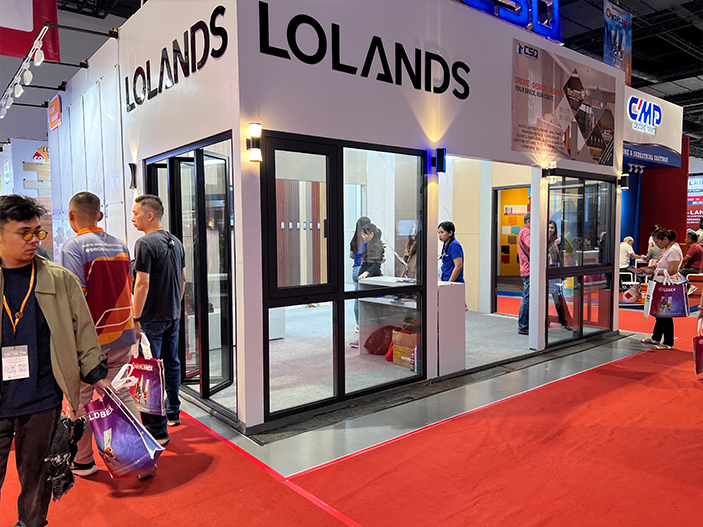
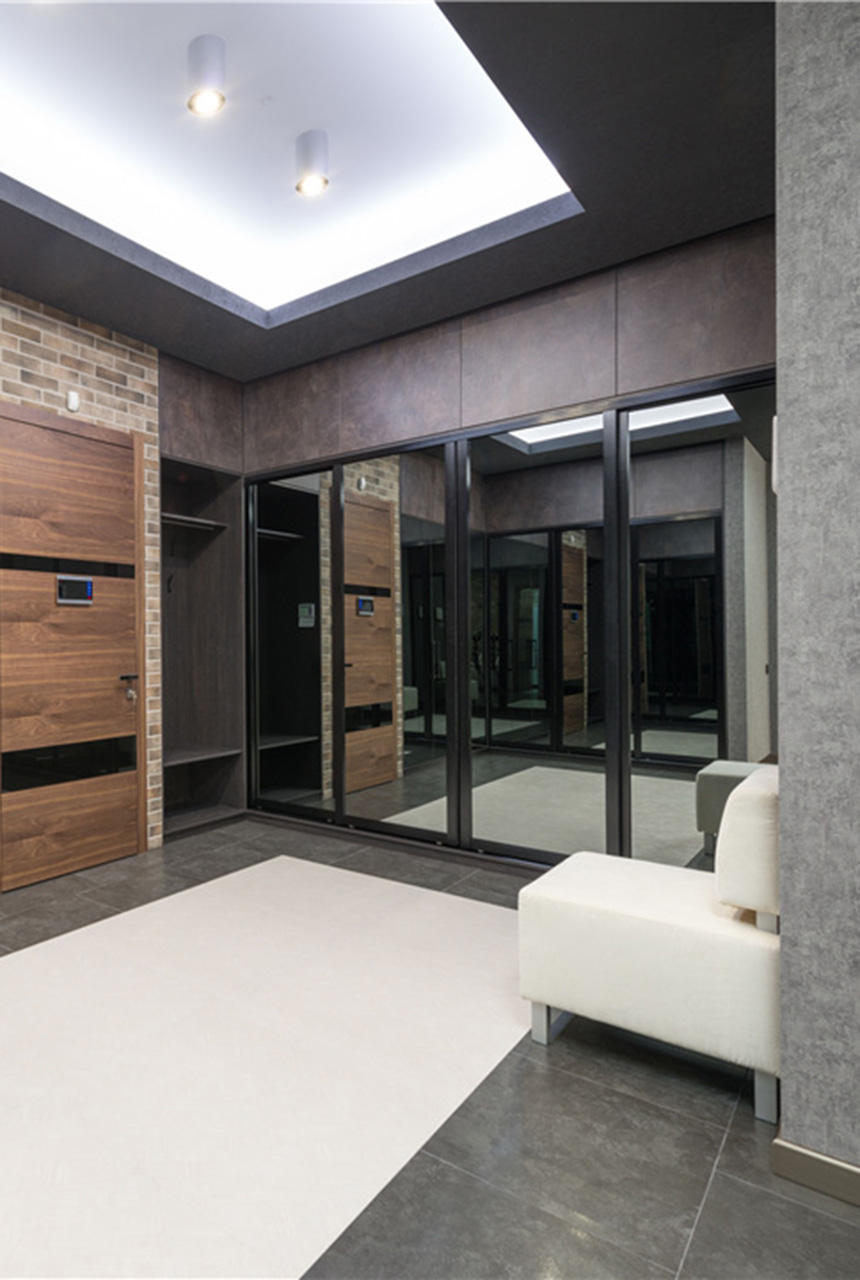
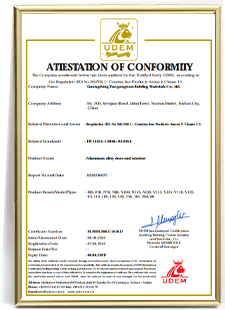
30,000 m² Production Base
Located in Foshan, Guangdong—the hardware and aluminum extrusion capital of China—our automated facility houses double-head precision cutting saws, 5-axis CNC machining centers, and automated glass insulating lines for consistent dimensional tolerances within $\pm 0.5\text{mm}$.
Full CAD/BIM OEM Customization
Our dedicated technical engineering department turns your CAD drawings or architectural schematics into detailed shop drawings. We support custom extrusion profile die creation, hardware milling customization, and rapid 3D sample prototyping for project bidding.
Comprehensive Quality Audit & Test Laboratory
Every batch of front glass doors undergoes rigorous quality control checks, including air-tightness pressure testing, water spray chamber tests, hardware opening lifecycle tests (100,000 cycles), and CASS salt-spray corrosion resistance tests.
Frequently Asked Questions by Japanese Buyers & Contractors
Addressing essential technical, logistics, and compliance inquiries for smooth importation into Japan.
How do your OEM/ODM aluminum front doors comply with Japanese JIS standards?
Our engineering team designs profiles according to JIS A 4702 (Doorsets) and JIS A 4706 (Windows) structural guidelines. We utilize high-grade 6063-T5/T6 aluminum alloys, PA66GF25 thermal insulation strips, and double/triple tempered safety glass. Official test documentation and mill certificates can be provided for project submission to Japanese building authorities.
Can you customize door dimensions and lock cutouts for Japanese hardware brands like MIWA or GOAL?
Yes. We regularly perform custom CNC milling for Japanese mortise locksets, electronic strike plates, panic hardware, and smart keyless entry systems (including MIWA, GOAL, and Ryobi door closers). Buyers simply provide the technical template or hardware samples, and our engineering department will adjust profile machining drawings accordingly.
What are your typical OEM lead times and ocean shipping arrangements to Japanese ports?
For standard custom orders, production takes 25 to 30 days from final shop drawing confirmation. Transit times from Shenzhen or Guangzhou ports to major Japanese ports (Tokyo, Yokohama, Nagoya, Osaka, Kobe) are exceptionally fast—typically taking only 4 to 7 days in transit. We provide export-grade fumigated wooden crates with protective film and corner bumpers to prevent damage during shipment.
How do your glass front doors perform against severe typhoons and rainstorms in coastal Japan?
Our typhoon-rated exterior door series utilizes pressure-equalized internal drainage chambers, continuous multi-layer EPDM gaskets, and heavy-duty multi-point locking rods. This setup withstands wind pressures up to 3600 Pa (S-6 Grade) and prevents water penetration even under 500 Pa rainstorm pressure cycles.
What is the Minimum Order Quantity (MOQ) for custom OEM projects in Japan?
We offer flexible procurement options. For standard custom residential projects or commercial trials, our MOQ starts at just 5 sets. For large-scale multi-family development projects or wholesale distributor stock orders, bulk pricing structures are available.
What surface finishes are recommended for long-term durability in Japan’s climate?
We highly recommend our 25-micron electrophoretic anodized finishes or 3-coat PVDF (Fluorocarbon) coatings. These treatments provide outstanding resistance against salt fog, sulfur, industrial pollutants, and intense solar radiation, retaining color stability and gloss over decades of outdoor exposure.
Request a Technical Quote & CAD Engineering Consultation Today
Send us your door schedule, opening dimensions, or CAD drawings. Our export engineering team responds within 24 business hours with detailed technical proposals and factory-direct pricing.