Global Procurement Guide: Top China Aluminium Standard Doors Supplier Selection & Future Trends
Selecting a top-tier Aluminium Standard Doors Supplier in China requires an in-depth analytical approach spanning architectural metallurgical standards, window profile design, thermal performance metrics, and global logistics logistics. As international building codes mandate stricter energy efficiency (low U-values) and higher wind-load structural resistance, direct factory-sourcing strategy from premier manufacturing hubs like Foshan has become a crucial competitive edge for project developers, importers, and general contractors.
Strategic Procurement Insight: Modern architectural projects no longer treat door and window fenestrations as standalone components. Instead, high-performance building envelopes rely on engineered system windows and thermal break door assemblies that directly reduce HVAC operational consumption while extending structural lifespan against harsh climates.
1. Future Trends in Architectural Aluminium Door Procurement (2025–2030)
The global market for standard aluminum doors and window assemblies is undergoing four major structural evolutions driven by sustainability regulations, modern architectural aesthetics, and advanced manufacturing automation:
A. High-Ratio Thermal Isolation
Transitioning from non-thermal break profiles to multi-cavity thermal break extrusions integrated with PA66GF25 (25% fiberglass reinforced polyamide) thermal barriers. Combined with low-emissivity (Low-E) double or triple glazing filled with 90%+ Argon gas, these systems achieve U-values under 1.4 W/m²K, satisfying strict Net-Zero carbon building mandates across North America and Europe.
B. Ultra-Slim Sightlines & Concealed Hardware
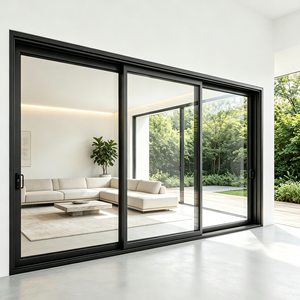
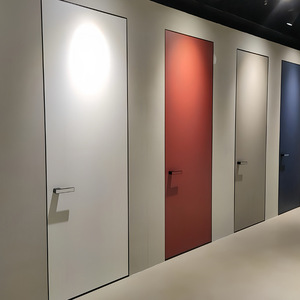
Commercial and luxury residential trends heavily favor minimalist architectural frames. Sub-20mm ultra-narrow interlocking styles, frameless pocket-sliding configurations, and 18mm hidden flush door profiles maximize interior light transmission without sacrificing structural wind load rigidity or acoustic dampening.
C. Severe Weather Resilience
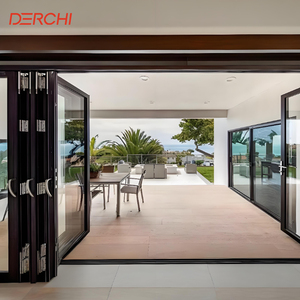
Coastal developments require doors designed specifically for impact resistance and anti-corrosion. Heavy-duty bifold and sliding doors incorporate hurricane-rated PVB/SGP laminated safety glass, heavy-wall aluminum alloys (2.0mm to 3.0mm thickness), and multi-point perimeter locks to pass rigorous ASTM E1886/E1996 and Australian AS2047 cyclic pressure tests.
2. Engineering Specification Matrix: Material Science & Quality Metrics
When evaluating China standard door manufacturers, procurement teams must verify the underlying technical specifications to ensure long-term durability and structural safety. The table below outlines our standard production benchmarks against typical commercial requirements:
| Performance Parameter |
Vexis Standard Specification |
Commercial Grade Benchmark |
International Standard Tested |
| Aluminium Alloy Billet |
Primary 6063-T5 / T6 High-Purity Extrusion |
6063-T5 Standard Grade |
GB/T 5237.1 / ASTM B221 |
| Structural Profile Wall |
1.4mm (Windows) to 2.0mm–3.0mm (Heavy Doors) |
1.2mm – 1.4mm |
AS2047 / EN 12208 |
| Thermal Barrier Strip |
PA66GF25 Polyamide Insulation Cavity |
Standard PVC / Low-grade Nylon |
ISO 2577 / DIN 16941 |
| Glazing Matrix |
5mm+12Ar+5mm Double Low-E / Triple Tempered |
Single/Double Float Glass |
IGCC / EN 12150 / AS2208 |
| Surface Treatment |
AkzoNobel Powder Coat / PVDF / Anodized 25μm |
Standard Spray Paint |
AAMA 2604 / AAMA 2605 |
| Acoustic Damping (STC) |
38 dB – 45 dB (Multi-chamber EPDM seals) |
28 dB – 32 dB |
ISO 10140-2 / ASTM E90 |
| Hardware & Locking |
CMECH / Siegenia / Hoppe Multi-Point Locks |
Single-Point Standard Locks |
EN 13126 / PAS 24 |
3. Production Metallurgy & Surface Finishing Excellence
A primary factor distinguishing a premium Aluminium Standard Doors Supplier from low-cost assemblers is complete control over the surface treating and profile finishing processes. Architectural aluminum extrusions exposed to atmospheric pollutants, UV radiation, and salt spray require specialized chemical pretreatments:
A. Fluorocarbon (PVDF) Coatings: Ideal for high-rise commercial facades and oceanfront properties, our 3-coat/2-bake PVDF finishes (containing 70% fluorocarbon resin) resist color chalking, fading, and chemical erosion for up to 30 years under severe UV exposure.
B. Electrophoretic & Anodized Finishes: Providing a metallic satin aesthetic, anodizing increases oxide film thickness beyond 25 microns, making the door frame impervious to mechanical scratching while eliminating oxidation rust.
C. Wood Grain Thermal Transfer: Combining the natural organic warmth of timber with the structural stability of aluminum, advanced Italian thermal transfer technology fuses wood-grain patterns deep into the powder layer, preventing peeling or moisture warping typical of real wood entrance doors.
4. Quality Assurance Protocol & Export Packaging
To safeguard large-format glass doors, bifold patio systems, and custom casement sashes during ocean freight, Vexis enforces a strict 5-stage Quality Control protocol:
- Raw Material Spectrometry: Testing incoming aluminum billets for chemical alloy ratios prior to furnace extrusion.
- Dimensional CAD Inspection: Precision laser checking of mitred corner angles, gasket retention channels, and frame tolerances.
- Water & Air Mock-up Testing: In-house pressure chamber verification to ensure zero leakage under simulated typhoon rainstorms.
- Dry Film Thickness Measurement: Checking powder coating consistency (60-80 microns average) across all exposed profile faces.
- Export Steel & Wood Crating: Sashes are individual blue-film wrapped, corner-protected with high-density EPE foam, and secured inside fumigated non-wood or heavy-duty plywood crates with steel bands for LCL/FCL shipping.