Architectural Product Catalog
Featured OEM/ODM Door & Window Assemblies
Direct factory production engineered to global project standards including NFRC, AS2047, and CE certifications. Explore our benchmark patio door and fenestration lines.
Architectural Systems Engineering: The Technical Anatomy of Aluminum Clad Patio Doors
In high-end architectural developments, the choice of patio fenestration dictates both energy efficiency scores and long-term envelope durability. OEM/ODM Aluminum Clad Patio Doors represent the convergence of organic structural aesthetics and modern metallic weatherproofing. By combining an interior solid wood timber frame (such as European Oak, German Beech, or Sustainable Pine) with an exterior heavy-duty extruded aluminum cladding shell, manufacturers eliminate the inherent maintenance vulnerabilities of traditional timber while preserving luxury indoor visual warmth.
The structural performance of aluminum clad patio doors hinges on the separation of materials. Because wood and aluminum possess vastly different thermal expansion coefficients—extruded aluminum moves at approximately 23.1 × 10⁻⁶ /K whereas natural wood moves at roughly 4.0 × 10⁻⁶ /K—direct rigid bonding leads to structural warping, seal failure, and interior timber stress over thermal cycles. Advanced OEM/ODM factories utilize snap-on nylon or polyamide clip system connections that preserve a 3mm to 5mm continuous air cushion between the metal jacket and the wooden frame, ensuring independent linear movement and eliminating internal vapor condensation.
Information Gain Benchmark: High-performance OEM/ODM aluminum clad patio door assemblies incorporate continuous multi-cavity PA66 GF25 (25% Glass Fiber Reinforced Polyamide) thermal break strips within the aluminum profile, achieving structural frame thermal resistance values capable of driving total system U-factors down below 0.16 BTU/h·ft²·°F (0.90 W/m²K).
Phenomenological Comparison Matrix: Patio Door Material Systems
When evaluating structural performance for commercial resorts, multi-family developments, and luxury residential projects, engineering teams analyze mechanical loading, thermal conductivity, and life-cycle maintenance costs:
| Performance Parameter |
Aluminum Clad Wood Patio Doors |
Standard Thermal Break Aluminum |
Vinyl / uPVC Systems |
| Average System U-Factor |
0.14 - 0.22 BTU/h·ft²·°F |
0.24 - 0.32 BTU/h·ft²·°F |
0.26 - 0.35 BTU/h·ft²·°F |
| Acoustic Rating (STC / OITC) |
STC 38 - 45 dB (Superior Mass Density) |
STC 32 - 38 dB |
STC 28 - 34 dB |
| Exterior Finish Longevity |
AAMA 2605 PVDF Coating (30+ Yrs) |
AAMA 2604 / 2605 Powder Coat |
UV Degradation / Color Fading (8-12 Yrs) |
| Interior Aesthetic Grade |
Architectural Grade Natural Timber |
Anodized / Metallic Powder Finish |
Standard Monolithic Plastic Profile |
| Structural Wind Load Resistance |
Up to 4500 Pa (Commercial Grade) |
Up to 5000 Pa (Heavy Duty) |
Up to 2200 Pa (Residential Restricted) |
Future Sourcing & Procurement Trends (2025–2030 Commercial Outlook)
Global fenestration procurement is undergoing a paradigm shift driven by strict building performance mandates, such as the European Union’s Energy Performance of Buildings Directive (EPBD) and North America’s ENERGY STAR® Version 7.0 specs. Overseas buyers, commercial contractors, and architectural hardware distributors must realign their sourcing matrices to meet four core macro trends:
Passive House & Ultra-Low U-Values
Demand is rapidly pivoting toward triple and quadruple-glazed argon/krypton filled units featuring Warm-Edge composite spacers, pushing frame profiles to accommodate glass units over 44mm thick.
Ultra-Slim Sightline Architecture
Architects specify structural glass-to-frame ratios maximizing daylight autonomy. OEM manufacturers are re-engineering interlocking stiles down to 20mm-25mm visible width without sacrificing structural deflection limits.
Automated Motorized Systems
Smart building integration requires OEM patio doors to accept concealed electromagnetic drive units, rain/wind automated sensors, and biometric multi-point locking assemblies compatible with smart home protocols.
Decarbonized Material Traceability
Tier-1 international project tenders now mandate Environmental Product Declarations (EPDs), certified FSC/PEFC timber sourcing, and low-carbon primary aluminum billet processed using hydropower generation.
Manufacturing Engineering Trends & Exterior Surface Science
The operational longevity of aluminum clad exterior systems under extreme climate exposure—ranging from sub-zero Canadian snowstorms to saline coastal salt-spray conditions—is governed by advanced metallurgy and surface polymer science.
1. Extrusion Alloy Precision & Structural Tempering
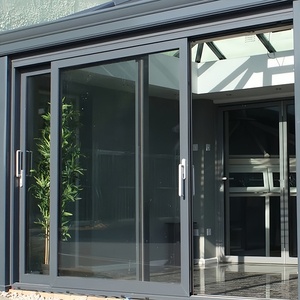
Professional OEM/ODM factories utilize primary 6063-T6 or 6060-T6 architectural grade aluminum extrusions with a minimum wall thickness of 2.0mm to 3.0mm for load-bearing sliding panel tracks and bifold sashes. The T6 heat treatment temper ensures tensile strength exceeds 205 MPa, preventing micro-deflection under positive and negative wind pressures up to 4.5 kPa.
2. Surface Treatment & Fluorocarbon Coating Mechanics
Exterior aluminum profiles undergo multi-stage chemical pretreatment (chromium-free conversion coating) followed by electrostatically applied 70% Kynar 500 / Hylar 5000 PVDF (Fluorocarbon) resin finishes compliant with AAMA 2605 specifications. This structural coating technology resists chalking, color fading, and salt atmospheric corrosion for over 30 years without degradation, far surpassing standard liquid or powder coatings.
3. Hydro-Pressurization & Isobaric Drainage Design
Water infiltration during storm conditions is neutralized via multi-chambered isobaric pressure equalization design. Internal weep holes equipped with gravity-assisted check valves allow immediate gravitational evacuation of incidental water, while continuous double or triple EPDM (Ethylene Propylene Diene Monomer) gasket loops maintain airtight pressure seals up to 900 Pa static water pressure standards.
Enterprise Advantage & Factory Direct Manufacturing Capabilities
Vexis Windows & Doors Co., Ltd. stands as an industry-leading Chinese system fenestration manufacturer based in Lishui Town, Foshan, Guangdong. Integrating R&D, structural engineering, precision production, and global export logistics, Vexis offers unmatched scalable capabilities for importers, architectural developers, and commercial contractors globally.
30,000 m² Advanced Production Hub
Equipped with fully automated European double-head precision cutting saws, CNC milling centers, and automatic corner-crimping machines ensuring zero-tolerance assembly accuracy.
Full-Cycle OEM/ODM Customization
From custom extrusion die development and shop-drawing BIM generation to specialized glazing configurations, hardware color-matching, and private labeling.
Ruggedized Maritime Export Packaging
All door panels and frames feature multi-layer protective film, custom corner protectors, cellular foam wrapping, and fully enclosed steel-reinforced fumigated wooden crates designed for zero-damage container transit.
Procurement & Technical Engineering FAQ
Essential technical guidance compiled by our senior export engineering team for international buyers, project architects, and volume importers:
What is the structural difference between aluminum-clad wood and wood-clad aluminum doors?
▼
Aluminum-Clad Wood Patio Doors utilize solid timber as the primary load-bearing structural core, protected externally by an aluminum weather shell. Conversely, Wood-Clad Aluminum Doors feature a heavy-duty thermal break aluminum frame as the main load-bearing structure, with thin decorative wooden interior fascia strips applied strictly for interior aesthetics. Aluminum-clad wood offers superior natural thermal insulation and timber mass, whereas wood-clad aluminum excels in structural spans and coastal weather durability.
How do your factories prevent interior wood rot and thermal bridge condensation?
▼
We implement a multi-stage protection engineering protocol: First, interior timber undergo vacuum pressure impregnation with eco-friendly anti-fungal preservative treatments. Second, our proprietary nylon clip system separates the exterior aluminum shell from the wood frame by a 3mm air gap, preventing cold thermal bridging and moisture accumulation. Third, PA66 GF25 thermal breaks isolate outer frame temperatures, keeping internal surface glass temperatures above condensation dew points.
Which global performance certifications can Vexis provide for project submission?
▼
Vexis products are fully verified for global project compliance. We provide complete testing documentation for North America (NFRC Thermal Ratings, AAMA Structural Performance, IGCC Sealed Insulating Glass), Australia/New Zealand (AS2047 Windows & Doors in Buildings, AS1288 Safety Glazing), and Europe (CE Marking under EN 14351-1, ISO 9001 Quality Management Systems).
What is the typical OEM/ODM production lead time for commercial container orders?
▼
Standard lead time for custom OEM/ODM patio door orders is 25 to 35 calendar days following shop drawing approval and deposit receipt. For complex projects requiring new extrusion die fabrication, custom anodizing, or specialized glass sourcing, die tooling adds approximately 10 to 14 days. We maintain dedicated fast-track production lines for urgent multi-family project schedules.
Can Vexis match custom architectural colors and premium hardware hardware brands?
▼
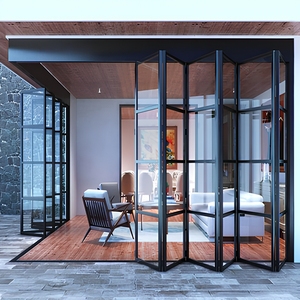
Yes. Exterior aluminum extrusions can be customized to any standard RAL color code, fluorocarbon metallic tone, or wood-grain sublimation pattern compliant with AAMA 2605 specs. For hardware systems, we offer integrated partnerships with premier European hardware manufacturers including Siegenia, Hoppe, Sobinco, and GU, as well as high-precision in-house stainless steel multi-point locking solutions.
What critical parameters should buyers submit to receive a fast engineering quotation?
▼
To receive a fully engineered shop proposal and line-item quotation within 24 hours, buyers should provide: (1) Wall opening elevation drawings or schedule dimensions; (2) Preferred door operating configuration (Lift & Slide, Multi-fold Accordion, French Hinged); (3) Glass performance requirements (Double/Triple Low-E, Argon gas, Tinting); (4) Destination port and local structural wind code requirements.
Partner with a Leading Foshan Patio Door OEM Factory
Streamline your commercial sourcing with factory-direct pricing, custom architectural CAD engineering, and certified export manufacturing tailored to your exact project specifications.
Get Catalog