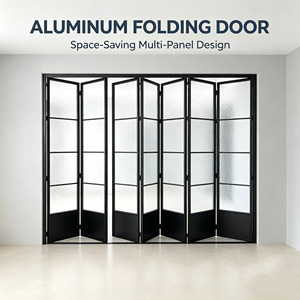
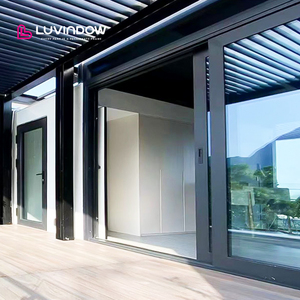
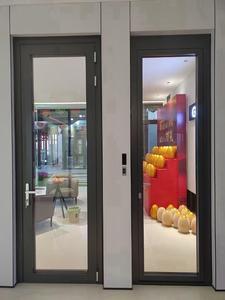
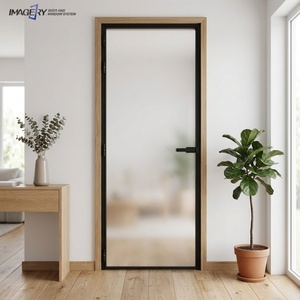
Architectural Blueprint: Structural Engineering of OEM Custom Aluminium Front Entrance Doors
In modern architectural engineering and high-end residential real estate development, the front entrance door serves as both the primary aesthetic statement and the critical defensive barrier of the building envelope. As an authority in factory-direct OEM/ODM manufacturing, Vexis Windows & Doors Co., Ltd. integrates decades of metallurgical expertise, precision structural engineering, and thermal barrier technology into every custom aluminium entrance door system produced at our 30,000 m² Foshan manufacturing base.
Aluminium alloy entrance doors have rapidly superseded traditional timber, steel, and unplasticized PVC (uPVC) alternatives in high-value global projects. Unlike timber, which suffers from hygroscopic expansion, warping, and organic degradation under ultraviolet radiation, architectural 6063-T6 and 6005-T6 extruded aluminium profiles maintain sub-millimeter dimensional stability across extreme thermal variances ranging from -40°C to +80°C. Furthermore, when compared to steel, aluminium offers exceptional strength-to-weight ratios combined with inherent atmospheric corrosion resistance—making it the definitive specification for coastal, humid, and high-wind environments.
Core Engineering Principle: True performance in custom aluminium entrance doors relies not merely on profile thickness, but on the structural cohesion of the multi-chamber thermal break system, structural adhesive bonding, and mechanical corner crimping under high-tonnage hydraulic force.
1. Thermal Insulation and Energy Efficiency: The PA66GF25 Polyamide Advantage
Standard solid aluminium profiles exhibit high thermal conductivity ($k \approx 200\text{ W/m}\cdot\text{K}$), which historical builders viewed as a thermal bridging vulnerability. Modern engineering solves this through advanced Thermal Break Technology. Our OEM front entrance doors incorporate reinforced PA66GF25 polyamide thermal barrier strips (25% glass fiber reinforcement) inserted between internal and external extrusion chambers.
This structural separation dramatically lowers the overall overall Heat Transfer Coefficient ($U$-value) of the door leaf and frame assembly to as low as $1.1\text{ W/m}^2\cdot\text{K}$ when combined with double- or triple-glazed Low-Emissivity (Low-E) insulated glass units (IGUs) filled with 90% Argon gas. The incorporation of continuous triple-layer EPDM (Ethylene Propylene Diene Monomer) gasket seals prevents thermal convection and forced air infiltration, complying with rigorous global energy standards including NFRC, CE Mark, and Australian AS2047 codes.
2. Technical Specification Matrix: OEM Aluminium Entrance Door Systems
Below is an engineering baseline comparison of our custom front entrance door configurations manufactured for global commercial and residential tenders:
| Performance Parameter | Thermal Break Grand Pivot Entrance | Heavy-Duty Hinged French Entrance | Bullet-Proof & Security Entrance |
|---|---|---|---|
| Profile Material | 6063-T6 / 6005-T6 High-Tensile Alloy | 6063-T6 Architectural Profile | 6005-T6 Reinforced Armor Core |
| Frame Wall Thickness | 2.0 mm – 3.0 mm Reinforced | 2.0 mm Standard Commercial | 3.0 mm – 4.5 mm Heavy Armor Profile |
| Thermal Barrier | PA66GF25 Multi-Chamber (24mm–34mm) | PA66GF25 Double Strip (20mm–24mm) | Composite Thermal & Acoustic Core |
| Thermal Performance ($U$-Value) | $1.1 - 1.4 \text{ W/m}^2\cdot\text{K}$ | $1.3 - 1.6 \text{ W/m}^2\cdot\text{K}$ | $1.4 - 1.8 \text{ W/m}^2\cdot\text{K}$ |
| Acoustic Damping ($R_w$) | 38 dB – 45 dB Sound Insulation | 36 dB – 42 dB Sound Insulation | 40 dB – 48 dB Extreme Isolation |
| Water Tightness (Pa) | Class 9A (600 Pa) | Class E750 (750 Pa) | Class E1050 (1050 Pa) |
| Wind Load Resistance | Serviceability: 2500 Pa / Ultimate: 5000 Pa | Serviceability: 3000 Pa / Ultimate: 6000 Pa | Ultimate Wind Pressure > 7500 Pa |
| Locking Hardware | Hydraulic Pivot + 5-Point Automatic Lock | German Siegenia / HOPPE Multi-Point | Motorized Biometric 7-Point Security Lock |
3. Acoustic Damping and Security Hardware Integration
For luxury villas, hotel entrances, and executive headquarters, acoustic control is vital. Sound energy attenuation is achieved through asymmetric double-laminated glazing units (e.g., $6\text{mm Clear} + 12\text{Ar} + 5\text{mm PVB} + 5\text{mm Clear}$) coupled with sound-dampening acoustic core infill panels. This multi-layered defense reduces ambient exterior noise pollution (such as traffic or airport noise) by up to 45 decibels ($R_w \ge 45\text{dB}$).
Security remains paramount in exterior entry design. Our OEM manufacturing process integrates European Standard C-groove and center-line hardware channels compatible with world-class multi-point locking hardware (including German GU, Siegenia, Roto, and Italian Savio systems). Heavy-duty stainless steel 304/316 friction hinges or concealed floor pivots engineered to withstand leaf weights up to 450 kg ensure smooth, effortless operation over 200,000 duty cycles.
Future Procurement Trends (2026–2030) for Global Door & Window Importers
The global architectural fenestration sector is experiencing a paradigm shift driven by stringent carbon-neutral building codes, smart city infrastructure, and extreme weather patterns. B2B buyers, project developers, and bulk importers must align their procurement strategies with several macro industry trends:
1. Smart Access & IoT Integration
Future-proof entrance doors require seamless integration with biometric facial recognition, RFID keypads, and smart-home automation protocols (Matter, Zigbee). Motorized multi-point locks with battery backups are becoming standard specifications in high-end projects.
2. Carbon Footprint & EPD Certification
International tenders increasingly require Environmental Product Declarations (EPDs) and low embodied carbon credentials. Utilizing recycled billet aluminium and energy-efficient anodizing/powder coating processes significantly boosts supplier evaluation scores.
3. Extreme Weather & Hurricane Ratings
With changing climatic conditions, coastal markets across North America, Australia, and Southeast Asia are mandating higher missile-impact resistance (ASTM E1996/E1886) and cyclic wind pressure resistance for front entrances.
4. Surface Treatment Innovations: Fluorocarbon PVDF vs. Powder Coating
Longevity under UV exposure and saline atmosphere is heavily dependent on surface finishing chemistry. Vexis offers high-performance surface finishes tailored to regional project specifications:
- Fluorocarbon PVDF Coating (Kynar 500): Ideal for severe marine and desert environments. Features a 3-coat/2-bake formulation providing superior color retention, chalk resistance, and a 25-year structural warranty against peeling or fading.
- AkzoNobel Interpon Powder Coating: Qualicoat Class 2 certified electrostatic powder application offering scratch-resistant matte, metallic, and textured finishes with zero volatile organic compounds (VOCs).
- Italian Thermosetting Wood-Grain Transfer: Combines the warmth and prestige of authentic hardwood aesthetics (Walnut, Oak, Teak) with the zero-maintenance resilience of heavy-gauge aluminium.