Choosing the right Aluminum Door begins with understanding the project, not browsing attractive product photos. A door for a coastal home faces salt air, strong winds, and frequent cleaning. A commercial entrance faces constant traffic, security concerns, and accessibility needs. These conditions influence the frame profile, glass specification, hardware, finish, and maintenance plan.
Measure the opening carefully. Check wall thickness, threshold height, drainage, surrounding materials, and available swing space. A small measurement error can create uneven gaps, difficult installation, or poor weather performance. Review the door’s thermal ratings, air leakage data, water resistance, and tested load capacity. Reliable suppliers should provide clear technical documents, warranty terms, and installation guidance. Local building requirements also need verification before ordering.
Material quality matters. Powder-coated aluminum can provide a durable finish, but surface preparation and coating quality still affect its service life. Choose insulated frames when indoor temperature control matters. Select laminated or tempered glass when safety and impact resistance are important. Think about daily use. A heavy entrance may need stronger hinges, a closer, and a more robust locking system.
No option is perfect. A slim frame may improve daylight but reduce thermal performance. Large glass panels can look elegant, yet they may increase heat gain or cleaning effort. I have seen projects focus on appearance and overlook drainage details. That mistake is expensive to correct. A practical decision balances design, performance, budget, and long-term care. This guide explains how to compare each factor with greater confidence.
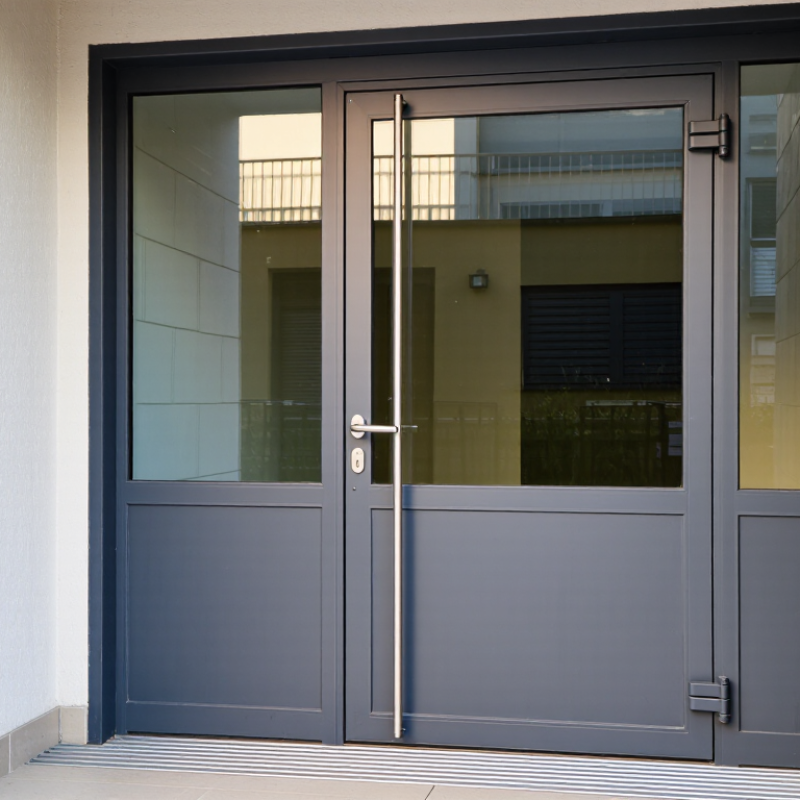
Define Project Use and Climate: Apply IECC Climate-Zone Requirements
Choosing an aluminum door starts with its location and daily purpose. A coastal entry needs corrosion resistance and careful water management. A north-facing door in a cold zone needs stronger thermal protection. A busy commercial entrance also needs durable hardware and controlled air leakage.
The 2021 International Energy Conservation Code (IECC) separates requirements by climate zone, occupancy, and door assembly. Its fenestration tables address U-factor and solar heat gain coefficient, while commercial provisions also consider air leakage and thermal continuity. These details matter because aluminum conducts heat quickly. The U.S. Energy Information Administration’s 2020 Residential Energy Consumption Survey reports that space heating and air conditioning use roughly half of household energy. A poorly selected door can increase that burden near the opening. In practice, I have seen projects specify excellent glass but ignore the frame, threshold, or installation gap. That decision weakens the whole assembly. It deserves reconsideration.
Tips: Identify the IECC climate zone before requesting quotations. Confirm the tested U-factor, SHGC, and air-leakage rating. Ask whether values cover the complete door assembly, not glass alone. Check the threshold height against local rain exposure. In hot climates, limit unwanted solar gain on west-facing entrances. In cold climates, prioritize insulated frames and continuous perimeter seals. Use NFRC-certified performance data when available. Always compare the design with the adopted local code, because jurisdictions may amend the model requirements.
Set Energy Targets: Compare NFRC U-Factor and SHGC Ratings
Choosing the right aluminum door starts with measurable energy targets, not appearance alone. NFRC ratings provide a reliable comparison between door systems. The U-factor measures heat transfer through the complete door assembly. Lower values usually indicate better insulation.
SHGC, or Solar Heat Gain Coefficient, measures how much solar energy enters through the glazed area. A high SHGC may help warm a shaded home during winter. However, it can increase cooling loads beside strong afternoon sunlight. Climate, window direction, glass size, and interior use all matter.
Look for the whole-unit NFRC label, not only the glass specification. The frame, edge seals, glass, and hardware can change real performance. Thermally broken aluminum frames often reduce conductive heat flow. Still, installation quality remains critical. A poorly sealed threshold can waste the advantage of an excellent rating.
I once compared doors by U-factor alone. That was too narrow. A low U-factor did not solve unwanted summer heat in a west-facing entry. Set practical targets before requesting quotes. For example, prioritize a lower U-factor in cold regions, then balance SHGC with shading. In hot, sunny areas, a lower SHGC may be more useful. Ask for documented NFRC values and confirm whether ratings apply to the exact size and configuration you plan to install. Ratings are helpful, but they are not the whole building.
Select Thermal Design: Use Thermal Breaks and Low-E Glass
How to Choose the Right Aluminum Door for Your Project?
Select Thermal Design: Use Thermal Breaks and Low-E Glass
A thermally efficient aluminum door begins with the frame, not the handle or finish. Choose a system with a continuous thermal break between the interior and exterior aluminum sections. This barrier reduces heat transfer through the frame and helps limit cold interior surfaces. In winter, that detail can reduce condensation around the door edges.
Low-E glass supports the same goal. Its microscopically thin coating reflects radiant heat while allowing useful daylight inside. Double glazing may suit moderate climates, while triple glazing can provide stronger insulation in colder regions. Check the complete door’s U-value, rather than relying only on the glass specification. The frame, spacer, seals, and glass all affect performance.
Small details matter.
I have seen projects specify excellent glass but overlook weak corner seals. Air leakage then reduced the expected comfort. A qualified installer should keep the thermal break aligned and seal the perimeter carefully. Warm-edge spacers can further reduce heat loss near the glass edge. However, a lower U-value is not automatically the best choice. Solar exposure, ventilation, humidity, and local weather should guide the selection. I once focused too heavily on insulation and underestimated summer heat gain. That mistake changed how I review door schedules. Thermal design needs balance, and the installation quality deserves equal attention.
Verify Air Performance: Target ≤0.3 cfm/ft² Leakage at 75 Pa
Choosing an aluminum door involves more than frame color, glass, or hardware. Air performance deserves early attention, especially in windy or conditioned buildings. Set a clear project target: air leakage at or below 0.3 cfm/ft² when tested at 75 Pa. This figure describes how much air passes through each square foot of door area under pressure. Lower leakage usually supports comfort, energy control, and quieter interiors. Still, it is a performance target, not a promise created by a catalog.
Ask for documented test results from a recognized independent laboratory or qualified testing agency. Confirm the tested door size, configuration, glazing, hardware, and pressure direction. A small sample can perform differently from a tall, frequently used entrance. Inspect the seal design closely. Continuous gaskets, accurate corner joints, and a compression latch help limit uncontrolled paths. Thresholds need special care. Uneven floors can leave a visible gap beneath the sweep.
Installation often decides whether the target survives the jobsite. I have seen well-designed doors lose performance because frames were twisted or sealant joints were incomplete. Check plumb, square, frame anchors, and gasket continuity before final adjustment. Retest when the entrance is critical. Do not rely on feel alone; a door can close smoothly and still leak. The honest limitation is that field conditions change, and 0.3 cfm/ft² may require better installation discipline than expected. Review maintenance access, too, because worn seals quietly increase leakage over time.
How to Choose the Right Aluminum Door for Your Project?
Verify Air Performance: Target ≤0.3 cfm/ft² Leakage at 75 Pa
The chart shows the maximum allowable air leakage for different door areas at a test pressure of 75 Pa. The limit is calculated as:
0.3 cfm/ft² × door area.
Compare the tested leakage of the complete door assembly with the applicable limit. A lower measured value indicates better resistance to uncontrolled air infiltration.
Confirm Durability: Check AAMA/WDMA/CSA A440 Performance Grades
When choosing an aluminum door, durability should be measured, not guessed. Check whether the product has been tested under AAMA/WDMA/CSA A440 performance requirements. These standards evaluate air leakage, water penetration, structural pressure, and operating force. Some door assemblies also receive forced-entry ratings. Ask for the test report, not only a sales statement.
Performance Grade, or PG, must match the project’s exposure. A coastal entrance may face wind-driven rain and stronger pressure than an interior commercial corridor. A higher PG can offer greater resistance, but it may also increase cost, weight, and hardware demands. Review the required design pressure, door size, glass type, and surrounding wall construction together. The rating applies to a tested assembly, not just the aluminum frame.
Installation can quietly weaken excellent test results. Uneven thresholds, missing fasteners, or poor perimeter sealing may cause leaks during the first storm. Check the installer’s method against the approved instructions. Field conditions are rarely perfect. That deserves attention. I would also confirm who performed the testing and whether the report matches the exact configuration being ordered. A familiar rating is not enough when the opening, hardware, or glazing changes.
How to Choose the Right Aluminum Door for Your Project? - Confirm Durability: Check AAMA/WDMA/CSA A440 Performance Grades
| Performance Class |
Typical Application Category |
Project Conditions to Consider |
What to Verify for the Door |
Selection Guidance |
| R — Residential |
Primarily one- and two-family dwellings. |
Residential exposure, local wind loads, building height, and the door’s location on the building. |
Confirm the tested product’s complete performance designation, including its Performance Grade (PG), and check that the report covers the specified door configuration and size. |
Consider when the project falls within the residential category and the tested ratings satisfy the project’s code and design requirements. |
| LC — Light Commercial |
Low-rise multi-family dwellings and light commercial buildings. |
Exposure to wind-driven rain, building orientation, floor level, and expected frequency of door operation. |
Review the product’s documented air-leakage, water-penetration, and structural test performance for the applicable configuration. |
Use as a class to evaluate for appropriate low-rise residential or light commercial projects; confirm suitability with the project specifications. |
| CW — Commercial |
Commercial buildings, including low- and mid-rise applications. |
Design wind pressure, building height, corner-zone exposure, entrance traffic, and water-management details. |
Match the tested PG and other reported results to the project’s required design pressures and performance criteria. Check size and hardware limitations. |
Consider where commercial use or project exposure requires performance beyond the project’s accepted residential or light-commercial criteria. |
| AW — Architectural |
High-rise and other buildings where demanding performance requirements apply. |
High wind exposure, elevated floors, severe weather, demanding operating conditions, and project-specific envelope requirements. |
Obtain the applicable test documentation and verify that the exact door assembly meets the specified structural, water, and air-performance requirements. |
Evaluate for projects with stringent requirements; the class alone does not establish that a product meets every project-specific criterion. |
| PG — Performance Grade |
A numeric rating associated with a product’s tested performance under the applicable standard edition. |
Project design pressures, local building-code requirements, site wind conditions, building geometry, and exposure category. |
Compare the product’s stated PG with the project’s required design pressure, and confirm the reported water-penetration and air-leakage results. |
There is no single PG that suits every project. Have the design professional establish the required performance and verify the product documentation before specification. |
Important: AAMA/WDMA/CSA 101/I.S.2/A440 class and PG ratings apply to tested products and configurations—not to aluminum doors as a material category. Confirm the applicable standard edition, certified test documentation, door size, glazing, hardware, and installation conditions against the project specifications and local code.
FAQS
Identify the local climate zone before requesting quotations. Cold areas need insulated frames and continuous perimeter seals. Coastal entrances need corrosion resistance and careful water management. West-facing doors in hot areas may need reduced solar gain. The correct choice depends on exposure.
Confirm the complete assembly’s U-factor, solar heat gain coefficient, and air-leakage rating. Do not inspect the glass alone. The frame, threshold, seals, and installation gaps also affect performance. I may overlook the threshold, but it can weaken the entire door.
A practical target is 0.3 cfm/ft² or lower at 75 Pa. This measures air passing through each square foot under pressure. Lower leakage can improve comfort, energy control, and indoor quietness. It remains a target, not a guaranteed result.
Request documented results from an independent laboratory or qualified testing agency. Check the tested size, glazing, hardware, configuration, and pressure direction. A small sample may not represent a tall, busy entrance. That difference matters.
Continuous gaskets, accurate corner joints, compression latches, and tight thresholds help control leakage. Uneven floors can leave a visible gap below the sweep. Worn seals may quietly increase leakage over time. A smooth-closing door can still leak.
Inspect plumb, square, frame anchors, sealant joints, and gasket continuity. Twisted frames can reduce performance, even with good materials. Check the opening before final adjustment. Retest critical entrances when possible.
Yes. Frequent use increases stress on hardware, seals, and alignment. Choose durable hardware and controlled air leakage. Inspect compression points and threshold contact regularly. Daily traffic exposes weak details quickly.
Compare the selected door with the locally adopted energy code. Local authorities may amend model requirements. Confirm climate-zone rules, occupancy conditions, and assembly performance. A quotation alone is not enough.
Conclusion
Choosing the right Aluminum Door begins with understanding how and where it will be used. Evaluate the project’s function, traffic level, exposure, and local climate, then apply the relevant IECC climate-zone requirements. Establish clear energy goals by comparing NFRC-rated U-Factor and Solar Heat Gain Coefficient (SHGC) values. Lower U-Factor can improve insulation, while an appropriate SHGC helps balance daylight, solar warmth, and cooling demand.
Next, review the door’s thermal design, including insulated frames, thermal breaks, and Low-E glass options. Air performance is also important; target air leakage of no more than 0.3 cfm/ft² at 75 Pa for improved comfort and efficiency. Finally, confirm long-term durability by checking AAMA, WDMA, or CSA A440 performance grades that match the project’s wind, water, structural, and operating requirements. A careful comparison of these factors will help ensure the selected Aluminum Door delivers reliable performance, energy efficiency, and lasting value.